
Alert issued
12 daysA −1.6 °C frost forecast for July 14 in Caxias do Sul, identified 12 days in advance.
- Event
- Frost
- Forecast for
- Lead time
- 12 days
- Location
- Caxias do Sul/RS
Rural credit portfolio of a credit cooperative in Southern Brazil.
Climate Risk Index, ESGreen Platform
The IRC-ESGreen (Climate Risk Index) measures physical climate risk by land parcel, contract and portfolio, converts the exposure into reais and indicates an action for each operation.
The video loads from YouTube only when you click.
Alert issued
12 daysA −1.6 °C frost forecast for July 14 in Caxias do Sul, identified 12 days in advance.
Rural credit portfolio of a credit cooperative in Southern Brazil.
Illustrative data: fictitious portfolio, does not represent real clients
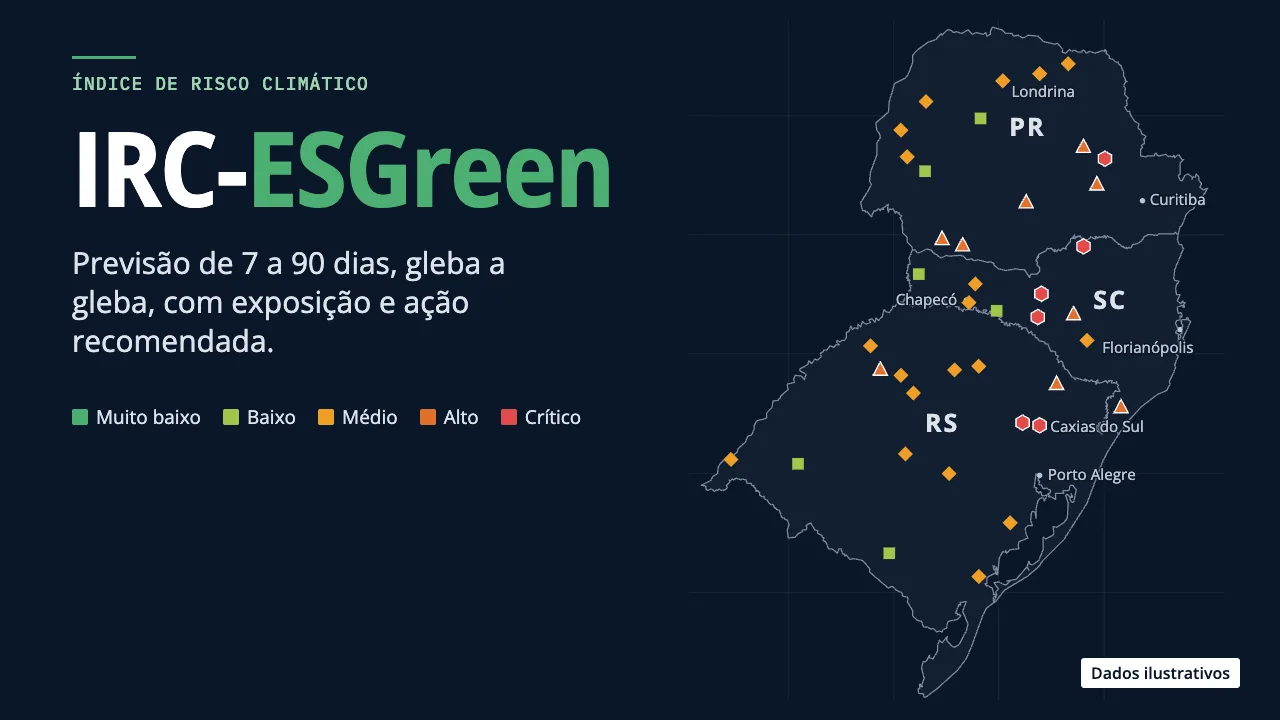
40 fictitious land parcels in Paraná, Santa Catarina and Rio Grande do Sul. Choose the horizon and see how the index, the exposure in reais and the suggested action change.
Demo run DEMO-2026-09-30-A, fictitious data, issued on
The demo could not be loaded. Reload the page or contact ESGreen to see the IRC-ESGreen with an expert.
Map of Paraná, Santa Catarina and Rio Grande do Sul with 40 fictitious land parcels colored by IRC band.
IRC band: the higher, the greater the risk
Each dot is a fictitious land parcel. Press Tab to enter the map and use the arrow keys to move through the land parcels, from the most critical to the least critical.
Horizon: 30 days
Portfolio average IRC
57 / 100
the higher, the greater the risk
Climate exposure
R$8.29M
estimated value at risk over the horizon
Contracts in the High or Critical band
15 of 40 (38%)
at least one land parcel with an IRC above 60
Predominant event
frost
most frequent among exposed land parcels
| # | Contract | Municipality/State | Crop | Forecast event | IRC | Band | Exposure | Suggested action |
|---|---|---|---|---|---|---|---|---|
| 1 | Fictitious contract 0020 G-020 | Videira/SC | grapes | frost | 94 | Critical | R$109K | block |
| 2 | Fictitious contract 0032 G-032 | Caxias do Sul/RS | grapes | frost | 87 | Critical | R$337K | provision |
| 3 | Fictitious contract 0010 G-010 | Castro/PR | beans | frost | 84 | Critical | R$190K | provision |
| 4 | Fictitious contract 0023 G-023 | Canoinhas/SC | beans | frost | 83 | Critical | R$484K | provision |
| 5 | Fictitious contract 0019 G-019 | Campos Novos/SC | soybean | frost | 81 | Critical | R$221K | provision |
Ranked by IRC over the selected horizon. Ties are ranked by exposure in reais.
The interactive demo needs JavaScript for the map and the tabs. The table below shows the same fictitious portfolio for the horizon of 30 days.
| Land parcel | Municipality/State | Crop | Stage | IRC | Band | Forecast event | Exposure | Suggested action |
|---|---|---|---|---|---|---|---|---|
| G-001 | Cascavel/PR | soybean | development | 33 | Low | water deficit | R$204K | require insurance |
| G-002 | Toledo/PR | corn | development | 44 | Medium | water deficit | R$95K | review limit |
| G-003 | Palotina/PR | soybean | development | 47 | Medium | water deficit | R$213K | review limit |
| G-004 | Umuarama/PR | corn | development | 44 | Medium | water deficit | R$157K | review limit |
| G-005 | Campo Mourão/PR | soybean | development | 40 | Low | extreme temperature | R$95K | require insurance |
| G-006 | Maringá/PR | soybean | development | 42 | Medium | extreme temperature | R$152K | review limit |
| G-007 | Londrina/PR | wheat | flowering | 51 | Medium | extreme temperature | R$79K | review limit |
| G-008 | Cornélio Procópio/PR | corn | development | 52 | Medium | water deficit | R$200K | review limit |
| G-009 | Ponta Grossa/PR | soybean | development | 75 | High | frost | R$412K | strengthen collateral |
| G-010 | Castro/PR | beans | planting | 84 | Critical | frost | R$190K | provision |
| G-011 | Tibagi/PR | wheat | flowering | 70 | High | frost | R$462K | strengthen collateral |
| G-012 | Guarapuava/PR | wheat | flowering | 74 | High | frost | R$368K | strengthen collateral |
| G-013 | Pato Branco/PR | corn | development | 72 | High | frost | R$357K | strengthen collateral |
| G-014 | Francisco Beltrão/PR | beans | planting | 72 | High | frost | R$240K | strengthen collateral |
| G-015 | Chapecó/SC | corn | development | 42 | Medium | water deficit | R$81K | review limit |
| G-016 | Xanxerê/SC | soybean | development | 47 | Medium | water deficit | R$174K | review limit |
| G-017 | São Miguel do Oeste/SC | corn | development | 39 | Low | water deficit | R$125K | require insurance |
| G-018 | Concórdia/SC | corn | development | 32 | Low | water deficit | R$45K | require insurance |
| G-019 | Campos Novos/SC | soybean | development | 81 | Critical | frost | R$221K | provision |
| G-020 | Videira/SC | grapes | flowering | 94 | Critical | frost | R$109K | block |
| G-021 | Curitibanos/SC | beans | planting | 67 | High | frost | R$288K | strengthen collateral |
| G-022 | Lages/SC | corn | development | 57 | Medium | frost | R$220K | review limit |
| G-023 | Canoinhas/SC | beans | planting | 83 | Critical | frost | R$484K | provision |
| G-024 | Turvo/SC | irrigated rice | development | 62 | High | extreme rainfall | R$865K | strengthen collateral |
| G-025 | Passo Fundo/RS | soybean | development | 55 | Medium | frost | R$267K | review limit |
| G-026 | Carazinho/RS | wheat | flowering | 54 | Medium | frost | R$92K | review limit |
| G-027 | Cruz Alta/RS | soybean | development | 46 | Medium | extreme rainfall | R$161K | review limit |
| G-028 | Ijuí/RS | soybean | development | 54 | Medium | extreme rainfall | R$131K | review limit |
| G-029 | Santo Ângelo/RS | wheat | flowering | 64 | High | extreme rainfall | R$310K | strengthen collateral |
| G-030 | Santa Rosa/RS | soybean | development | 49 | Medium | extreme rainfall | R$219K | review limit |
| G-031 | Vacaria/RS | corn | development | 67 | High | frost | R$265K | strengthen collateral |
| G-032 | Caxias do Sul/RS | grapes | flowering | 87 | Critical | frost | R$337K | provision |
| G-033 | Bento Gonçalves/RS | grapes | flowering | 79 | Critical | frost | R$77K | provision |
| G-034 | Santa Maria/RS | soybean | development | 45 | Medium | extreme rainfall | R$100K | review limit |
| G-035 | Cachoeira do Sul/RS | irrigated rice | development | 50 | Medium | extreme rainfall | R$106K | review limit |
| G-036 | Camaquã/RS | irrigated rice | development | 51 | Medium | extreme rainfall | R$78K | review limit |
| G-037 | Pelotas/RS | irrigated rice | development | 54 | Medium | extreme rainfall | R$238K | review limit |
| G-038 | Bagé/RS | soybean | development | 36 | Low | water deficit | R$35K | require insurance |
| G-039 | Alegrete/RS | irrigated rice | development | 40 | Low | no relevant event | R$0 | monitor |
| G-040 | Uruguaiana/RS | irrigated rice | development | 44 | Medium | water deficit | R$44K | review limit |
In this demo, a land parcel enters the risk count when its IRC for the selected horizon falls in the High (61–75) or Critical (76–100) band. A contract is counted once, by its most exposed land parcel. Climate exposure adds up the estimated value at risk of each contract over the horizon. All names, values and locations are fictitious.
Want to see the IRC-ESGreen on your portfolio?
Request a demo with your portfolioIn the demo with your institution's data, we start from a portfolio or a sample of operations you define.
The question
Your institution measures credit, market and operational risk. But can it anticipate the climate impact by contract?
The analyst does not need to interpret a climate model. They get risk, value and visibility.
From harvest to balance sheet
The problem isn't just that the climate is changing. It's the loss reaching the portfolio without warning.
Differentiator
| Rearview mirror | Windshield |
|---|---|
| Historical average | Forecast from 7 to 90 days |
| Municipal view | Analysis by coordinate |
| Explains past events | Identification of land parcels and contracts |
| Little connection with current contracts | Financial exposure and preventive action |
| Before the IRC-ESGreen | With the IRC-ESGreen |
|---|---|
| Historical, aggregated view | Forecast from 7 to 90 days |
| Reaction after the event | Risk by land parcel and operation |
| Hard to link climate to the contract | Exposure in reais |
| Scattered evidence | Ranking of critical contracts |
| Climate risk handled separately from the financial decision | Suggested action and traceable evidence |
The differentiator is not forecasting rain. It is identifying which operations may be affected and what to do beforehand.
The product
| Band | Range | Example (illustrative) | Suggested action |
|---|---|---|---|
| Very low | 0–25 | Soybean operating-cost loan on a land parcel with no relevant event forecast over the horizon. | monitor |
| Low | 26–40 | Corn operating-cost loan with above-average rainfall forecast far from harvest. | monitor |
| Medium | 41–60 | Water deficit forecast at the grain-filling stage, with no insurance in place. | require insurance |
| High | 61–75 | Frost forecast during wheat flowering, on an operation with collateral below the outstanding balance. | review limit or strengthen collateral |
| Critical | 76–100 | Extreme rainfall forecast at harvest, on a concentrated land parcel and a contract with a renegotiation history. | provision or block |
Illustrative examples The suggested action considers the index, the exposure and the terms of each contract.
Risk + value + action, on the same line.
Methodology
Probabilistic ensemble forecast, updated daily, recalculated every run, ~5 km resolution
The weights between the pillars and how they are combined are described in the methodology note.
Real-world proof
Rural credit portfolio of a credit cooperative in Southern Brazil.
Forecast minimum temperature in Caxias do Sul
| Date | Median | Likely range | Observed |
|---|---|---|---|
| 6/28 | — | — | 11.2 °C |
| 6/29 | — | — | 10.4 °C |
| 6/30 | — | — | 12.0 °C |
| 7/1 | — | — | 10.8 °C |
| 7/2 | 9.6 °C | 8.8 to 10.4 °C | 9.6 °C |
| 7/3 | 9.0 °C | 8.0 to 10.0 °C | — |
| 7/4 | 8.2 °C | 6.9 to 9.5 °C | — |
| 7/5 | 7.4 °C | 5.9 to 8.9 °C | — |
| 7/6 | 8.0 °C | 6.2 to 9.8 °C | — |
| 7/7 | 7.0 °C | 5.0 to 9.0 °C | — |
| 7/8 | 6.0 °C | 3.8 to 8.2 °C | — |
| 7/9 | 5.2 °C | 2.7 to 7.7 °C | — |
| 7/10 | 4.0 °C | 1.3 to 6.7 °C | — |
| 7/11 | 3.0 °C | 0.0 to 6.0 °C | — |
| 7/12 | 1.8 °C | −1.4 to 5.0 °C | — |
| 7/13 | 0.2 °C | −3.2 to 3.6 °C | — |
| 7/14 | −1.6 °C | −5.3 to 2.1 °C | — |
| 7/15 | −0.4 °C | −4.3 to 3.5 °C | — |
| 7/16 | 1.4 °C | −2.8 to 5.6 °C | — |
| 7/17 | 3.4 °C | −1.0 to 7.8 °C | — |
| 7/18 | 5.0 °C | 0.4 to 9.6 °C | — |
Alert issued
D-12
A −1.6 °C frost forecast for July 14 in Caxias do Sul, identified 12 days in advance.
D
, forecast date of the event
In a study of events in Rio Grande do Sul between April and May 2026, with ten companies from the South and Southeast, ESGreen's forecast model, the basis of the IRC-ESGreen, flagged extreme events up to 18 days in advance. The April 20, 2026 run indicated two waves of instability over the state, confirmed on May 1, 2026, with 324 mm in seven hours in Rosário do Sul.
Source: Economia SC, May 15, 2026.
of the analyzed portfolio showed some level of exposure to extreme climate events in the previous two years, in a study with more than 1,000 areas and properties in the South Region.
Launched at FEBRABAN TECH 2026, August 24–26, 2026, in São Paulo.
Lead time in specific cases does not guarantee accuracy in other events. The comparison requires a methodological basis, a sample and statistical evidence for the analyzed subset.
Financial scenarios
Portfolio climate exposure over the analyzed horizon (example).
Bar chart with three portfolio climate exposure scenarios: favorable, R$1.88 million; base, R$2.36 million; severe, R$3.06 million.
The discussion is no longer only about climate. It becomes about exposure, limits, coverage and provisions.
Reading levels
Thermometer, risk × impact matrix and concentration by state and crop.
The most critical contracts first, with the suggested action alongside.
Risk timeline, index breakdown and spraying window.
One document per operation, ready to attach to the credit file and to reporting.
Illustrative data
The board sees the portfolio. The manager sees the contract. The regulator sees the evidence.
Delivery and integration
Regulation
It's turning regulatory requirements into opportunities and portfolio management, with evidence and an audit trail.
The new GRSAC rules have already been published and bring quantitative tables to the report, in stages: S1 and S2 disclose first, with data from a reference date before the disclosure. In other words, the exposure that will be published is already in today's portfolio. The public consultation that gave rise to the rule (CP 127) provided for exposure to drought and heavy rainfall by region. The IRC-ESGreen organizes this exposure by land parcel, contract and portfolio.
Report of sustainability-related financial information (CBPS 01 and 02, equivalent to IFRS S1 and S2) for financial institutions, with reasonable assurance by an independent auditor. It already applies to listed institutions and to the lead entities of conglomerates in segments S1 and S2, with S3 next. The IRC-ESGreen supports this reporting with a physical-risk evidence trail prepared for assurance.
CMN Resolution 5,268/2025 brought to section 9 of the MCR (Rural Credit Manual) the check for vegetation clearing using PRODES/INPE and remote-sensing monitoring of contracts above 300 ha, "documented, auditable and assessable by the Central Bank". The IRC-ESGreen adds climate risk by land parcel, with the source, date and version of each run.
Climate-related disclosures, with physical risk, scenario analysis and financial effects. Mandatory for financial institutions under CMN Resolution 5,185 and voluntary for listed companies (CVM 193/244). The IRC-ESGreen's three scenarios in reais feed this analysis.
In force for rural insurance: no coverage for a property without an active CAR (Rural Environmental Registry), under an embargo for illegal deforestation or with the producer on the slave labor list. The IRC-ESGreen's ESG pillar and the ESGreen Score support these checks by CPF, CNPJ and property.
Requires institutions of the National Financial System, cooperatives included, to have a Social, Environmental and Climate Responsibility Policy. The IRC-ESGreen takes the policy down to the operation level, with evidence of climate risk by contract.
| Official zoning (ZARC) | IRC-ESGreen |
|---|---|
| Static, by municipality and by crop season. | Dynamic, per land parcel, recalculated with every run. |
Cross-referencing with a dynamic analysis can reveal exposures that aggregate zoning does not show at the operation level. The comparison requires a methodological basis, a sample and statistical evidence for the subset analyzed.
Who it is for
Members' rural portfolio, with the risk of the current crop season by land parcel. This is where the IRC-ESGreen already runs on a real portfolio.
See solutions for credit cooperativesThe same index by account holder contract, in the credit pipeline and in the GRSAC.
See solutions for banksRural insurance underwriting and monitoring with the forecast climate by property.
See solutions for insurersThe same reading by land parcel and contract applied to the portfolio's underlying assets.
See solutions for asset managers and capital marketsThe IRC-ESGreen turns climate risk into an operational, regulatory and commercial advantage.
Technology
When you play it, the video loads from YouTube (youtube-nocookie.com) and Google may process browsing data. Cookie Policy
The video didn't load.
Watch on YouTube (opens in a new tab)The IRC-ESGreen combines probabilistic ensemble climate forecasting with ESGreen's proprietary ESG base and the data of each operation. The forecast models come from the NVIDIA Earth-2 ecosystem, and the IRC-ESGreen was trained on NVIDIA infrastructure.

Data infrastructure the financial market already uses: 60+ financial institutions use ESGreen technology. Data as of Sep 2026.
The interactive demo uses a fictitious portfolio. The numbers in the Real-world proof section come from a real portfolio, shown without identifying the client.
Request the IRC methodology note The methodology note is sent by email after you fill in the form.
Short answers to the most common questions.
Still have questions? Talk to an expert
It is ESGreen's Climate Risk Index: a scale from 0 to 100 that measures physical climate risk by land parcel, contract and portfolio, converts the exposure into reais and indicates an action for each operation. The higher the index, the greater the risk.
IRC = Climate + ESG + Operational. The Climate pillar considers rainfall, water deficit, frost, extreme temperature and wind by coordinate, weighted by crop stage. The ESG pillar uses the operator's ESGreen Score, by CNPJ or CPF, from 70+ auditable sources. The Operational pillar considers the loan type, collateral, coverage and history of the operation and of the member or account holder.
From 7 to 90 days, with readings at 7, 15, 30, 60 and 90 days, plus the historical baseline.
Climate data is updated daily, and the index is recalculated every run. Each run is dated and uses a registered version of the methodology.
0 to 25, Very low; 26 to 40, Low; 41 to 60, Medium; 61 to 75, High; 76 to 100, Critical. The IRC-ESGreen scale runs in the opposite direction to the ESGreen Score, in which the higher the score, the lower the risk.
ZARC is the official zoning, static, by municipality and by crop season. The IRC-ESGreen is dynamic, by land parcel, and recalculated every run. The two readings complement each other, and comparing them requires a methodological basis, a sample and statistical evidence for the analyzed subset.
In a real rural credit portfolio of a credit cooperative in Southern Brazil: 1,023 land parcels monitored, 414 contracts analyzed and 160 cities in Paraná, Santa Catarina and Rio Grande do Sul.
Through the API, in the origination flow; through a report per operation, ready to attach to the credit file; through alerts by forecast event and affected operation; and through the operational and executive dashboards.
No. The demo uses 40 fictitious land parcels and contracts, created only to illustrate how the index works.
No. The index is an assessment based on public and regulatory data and on proprietary models. The suggested action is an input, and the credit decision remains with the institution itself.
Schedule 30 minutes. We show the IRC-ESGreen applied to a portfolio or a sample of operations from your institution.
Or write to contato@esgreen.com.br